

A clogged condensate drain line is one of the most common reasons an AC system shuts down unexpectedly or causes water damage to a ceiling. The good news is that cleaning it yourself takes under 30 minutes and requires tools you probably already own. Here’s exactly how to do it safely.
How to Tell Your Condensate Drain Line Is Clogged
Your AC pulls moisture from indoor air as it cools. That moisture drips into a drain pan, then flows out of the house through the condensate drain line, a small PVC pipe that runs from your indoor air handler to the outside. When that pipe gets blocked, water has nowhere to go.
The most common signs of a clog are easy to spot. You might notice water pooling near your indoor unit, a water stain spreading across your ceiling, or a musty smell coming from the vents. Some systems have a float switch that cuts power to the unit when the pan fills up, so a sudden, unexplained shutdown is another red flag.
A few other signs worth checking:
- Standing water in the condensate pan under the air handler
- Slow or no dripping at the outdoor pipe end on a humid day (you should see steady drips when the system runs)
- A swampy or sour smell that gets stronger during long cooling cycles
- Higher indoor humidity than usual
Moisture forms whenever warm, humid air contacts a cold surface, exactly what happens at your evaporator coil. That steady moisture flow makes the drain line a perfect place for algae and biofilm to grow, which is why partial clogs can smell bad long before water starts backing up visibly.
If you catch a clog early, the DIY steps below work well. But if water is already reaching electrical components or the pan keeps refilling after you clear it, that’s a job for a certified technician. The team at Jack Frost Heating & Air Conditioning, Inc.’s maintenance service checks float switches, condensate pumps, and drain lines as part of every routine visit, so you’re not left guessing.
Why Regular Condensate Drain Cleaning Matters
East Tennessee summers are humid. Your AC runs hard from May through September, pulling gallons of moisture out of the air each day. All of that water flows through the same small pipe. Over time, dust, algae, and mold build up inside the line and slow drainage to a trickle , then a stop.
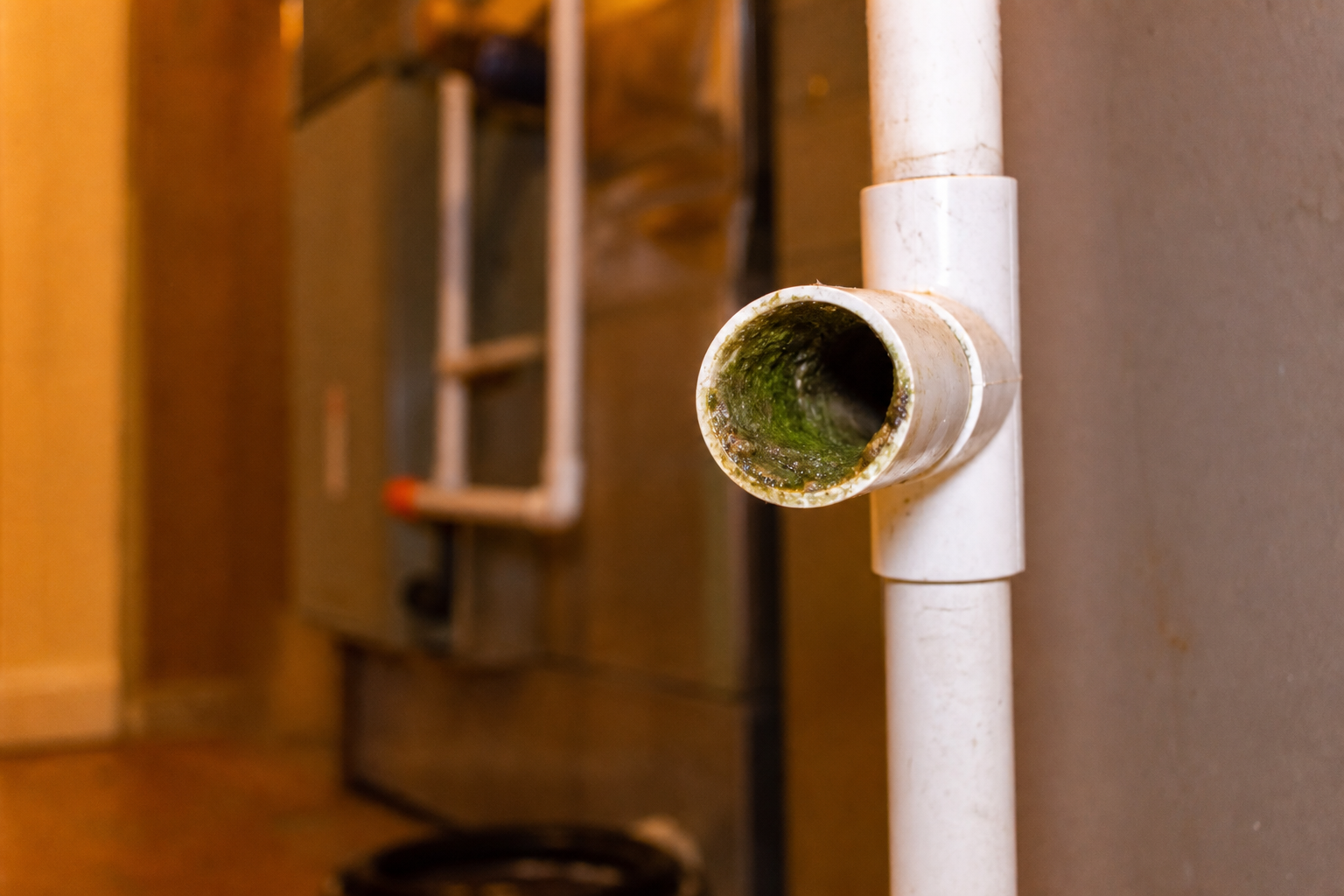
When the drain backs up, water overflows the pan. That water can soak into drywall, warp flooring, and trigger mold growth inside walls. A repair bill for ceiling drywall and mold remediation runs far higher than a season of monthly vinegar flushes. If the float switch isn’t installed or fails to trigger in time, the damage can happen silently while you’re away.
Beyond water damage, a blocked drain affects how well your system dehumidifies. If water can’t leave, humidity stays high indoors. Your AC works harder, runs longer, and still can’t reach the comfort level you set on the thermostat. Regular cleaning keeps all of that from happening.
If you’re worried about water damage your HVAC system might already have caused, our detailed look at HVAC water leaks, their causes, and when to call for repair covers how to spot hidden damage before it gets worse.
Step 1: Turn Off Your HVAC System and Locate the Drain Line
Before you touch anything, cut the power. Turn the thermostat to Off first, then go to your breaker box and flip the breaker for the HVAC system. This is the single most important safety step in the process. Every reliable guide on condensate maintenance lists this first, and for good reason , you’ll be working near the air handler where water and electricity are close together.
Put on rubber gloves and safety glasses before you start. Only about 38% of step-by-step guides mention personal protective gear, but it matters. The inside of a condensate line holds stagnant water, mold, and algae. You don’t want any of that splashing near your eyes.
Now find the drain line. It’s usually a white or gray 3/4-inch PVC pipe that exits from the bottom or side of your air handler. In most East Tennessee homes, the air handler sits in a utility closet, an attic, or a garage. The drain line runs from the unit, slopes downward, and exits the house , often near the outdoor condenser unit or through a wall to a floor drain.
You’ll also see a second, smaller line nearby. That’s the secondary drain, which only flows if the primary is blocked. If water is dripping from the secondary line, your primary is already clogged.
Look for a T-shaped fitting or a capped access port along the main line. That’s where you’ll pour the cleaning solution. Some lines have a clean-out cap right at the air handler; others have the access point a few feet down the pipe. Once you’ve found it, you’re ready for the next step.
By now you should have: power off at both the thermostat and breaker, gloves and eye protection on, and the access cap located on the drain line.
Step 2: Remove the Cap and Clear Visible Debris
Pull the cap off the access port. Set it somewhere you won’t lose it. Look down into the opening with a flashlight. If you see standing water, that tells you the blockage is downstream , water can’t move past it. If the pipe looks dry, the clog may be minor or near the outdoor end.
Use a gloved finger or a thin tool like a flexible bottle brush to clear any visible gunk from just inside the opening. Algae and biofilm tend to cluster at the access port and at the first bend in the pipe. Wipe out what you can reach.
If there’s standing water in the pan or the line, remove it now. A wet/dry vacuum works best here. Place the hose end over the outdoor drain outlet (the pipe end where water exits the house), wrap a towel around the joint to create a rough seal, and run the vacuum for one to two minutes. This suctions water and soft debris from the outside end toward you. You’ll often hear a gurgle and then a rush when the blockage clears.
Some homeowners skip this suction step and go straight to pouring solution in. That works for light maintenance, but if the line is already backed up, pushing more liquid into a blocked pipe just adds to the standing water. Clear the bulk of the clog first, then treat the line.
By now you should have: The cap removed, visible debris wiped out, and any standing water suctioned from the line or pan.
Step 3: Flush the Line With Vinegar or Hot Water
With the line cleared of the worst buildup, it’s time to treat what’s left. Pour about half a cup to one full cup of plain distilled white vinegar into the access port. Use a small funnel if the opening is tight. Vinegar is mildly acidic, which breaks down the biofilm and algae that cause slow drains and musty smells. It won’t harm PVC, and it won’t send caustic fumes back through your air handler the way bleach can.
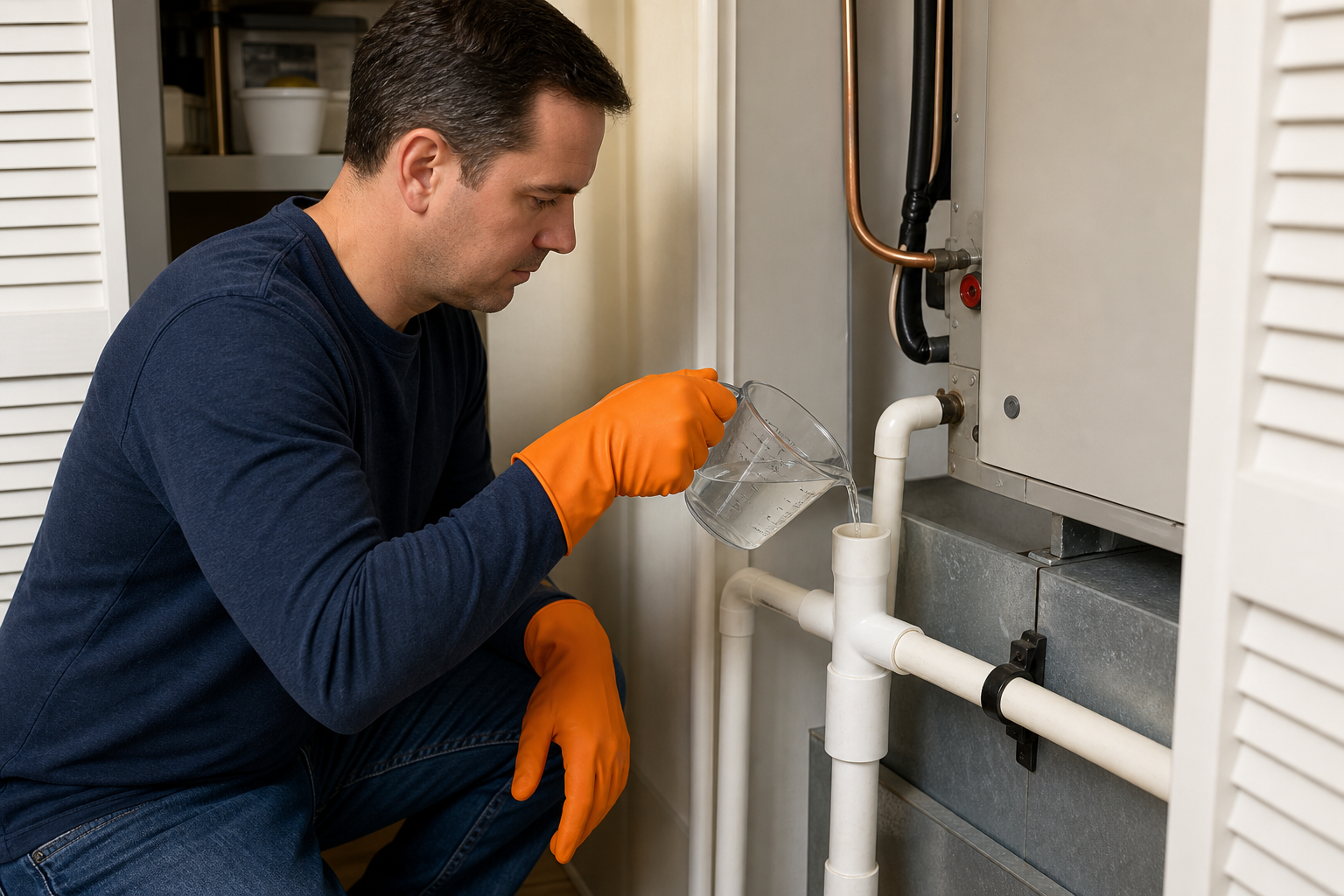
Let the vinegar sit for 30 minutes. Don’t rush this part. The dwell time is what does the work. After 30 minutes, follow it with at least two cups of clean water to push the vinegar and loosened debris all the way through the line and out the exterior end.
A quick note on bleach: some guides recommend a diluted bleach solution (one part bleach to ten parts water). Bleach does kill mold and algae effectively. But the fumes can travel back up a drain that doesn’t have a proper P-trap and reach your evaporator coil, which can corrode aluminum components over time. For regular monthly maintenance on a standard residential system, white vinegar is the safer long-term choice. If you do use bleach, never mix it with vinegar — that combination creates toxic chlorine gas.
Hot water alone is another option worth knowing about. If you don’t have vinegar on hand, running hot (not boiling) water through the line still loosens soft algae buildup and rinses the pipe. It won’t sanitize as well, but it beats skipping maintenance entirely.
By now you should have: vinegar or hot water flushed through the full length of the line, with clean water following behind it, and confirmed flow at the outdoor end.
Step 4: Handle Stubborn Clogs and Check the Condensate Pump
Sometimes a vinegar flush and a wet/dry vacuum aren’t enough. If the line still won’t drain freely after the flush, you’re dealing with a harder blockage , usually compacted algae in the P-trap or a section of pipe that sags and holds standing water.
For stubborn clogs, HVAC technicians often use a drain gun (sometimes called a CO2 gun). This tool fires an 800 psi burst of CO2 through the line, blasting the blockage loose. It’s compact and effective for material that a vacuum can’t reach. If you don’t own one, compressed air at no more than 30 psi through a vinyl tube can do a similar job. Don’t exceed that pressure , you risk blowing apart glued PVC fittings if the pipe has any weak joints.
Another option for a stubborn P-trap clog is to add PVC union fittings so you can disassemble that section, clean it in a sink, and put it back. It’s a one-time modification that makes future maintenance much faster. Some homeowners who deal with repeated clogs make this upgrade and report that annual cleaning now takes only a few minutes instead of an hour of frustration.
If your system has a condensate pump, check it too. A condensate pump is used when the drain line can’t rely on gravity , common in basement air handlers or in certain attic setups. To clean it: unplug the pump, disconnect the drain line from it, remove the reservoir cover, and rinse out the slimy buildup with water and a soft brush. The float inside the reservoir must move freely. If it’s gunked up, the pump won’t trigger when water rises and the pan will overflow. A quick vinegar-and-water rinse through the pump every year or two keeps it working reliably.
Also check the check valve on the pump’s discharge line. Blow a little air through it in the correct flow direction to confirm it isn’t packed with debris. A blocked check valve forces the pump to work against itself and shortens its life significantly.
If you’ve worked through all of these steps and the line still won’t stay clear, or if the pan keeps refilling within a day or two, that’s the point to stop and schedule a professional look. Recurring clogs often point to a pipe pitched the wrong way, a cracked drain pan, or algae embedded deep in the line that needs a proper flush with the right equipment. Curious about what a full tune-up covers and what it typically costs? Our guide on HVAC tune-up costs in East Tennessee breaks down what you should expect to pay and what’s included.
By now you should have: A fully clear drain line confirmed by steady outdoor flow, a condensate pump that’s clean with a freely moving float, and any stubborn clog resolved or escalated to a pro.
Preventive Tips: Float Switches, Frequency, and When to Call a Pro
The best way to handle a clogged condensate drain is to prevent one. For most East Tennessee homes, a monthly vinegar flush during the summer cooling season is the right rhythm. During spring and fall when the system runs less, every two to three months is fine. In winter, once before you shut the system down for the season is usually enough.
If your home has pets, runs the AC constantly, or sits in a particularly humid spot, lean toward monthly maintenance all year. Algae grows faster in warm, wet conditions , exactly what the inside of a condensate line is in July.
A float switch is one of the best low-cost protections you can add. This small sensor sits in the secondary drain pan or on the drain line itself. When water rises to a set level, it cuts power to the system before overflow can happen. Many newer systems have one installed from the factory. Older units often don’t. The EPA notes that moisture control is the key to preventing indoor mold growth, and a float switch is exactly that , automatic moisture control when your drain line fails.
Replacing your air filter on schedule (every one to three months, depending on your home) also reduces how much debris reaches the drain line in the first place. A clean filter means less dust and fewer particles to feed algae growth inside the pipe.
When should you call a professional instead of doing it yourself? A few clear situations:
- The pan has water sitting in it even after you clear the line
- The clog keeps coming back within a few weeks
- Water is near any electrical component in the air handler
- You can’t locate or access the drain line safely
- The system still won’t run after you’ve cleared the line and restored power
Water damage from a neglected drain line can affect your homeowner’s insurance claim , something worth knowing before a problem becomes expensive. Our article on how your HVAC system affects home insurance claims covers what insurers typically look for and how routine maintenance documentation helps.
The certified technicians at Jack Frost Heating & Air Conditioning, Inc. serve Seymour, Knoxville, and the surrounding East Tennessee area. A professional drain cleaning includes a full check of the float switch, condensate pump, and the drain pan , not just a vinegar pour. If something in the system needs a real fix, you’ll know before it becomes a water damage claim. Property managers dealing with multiple units will also find that scheduled maintenance visits are far cheaper than emergency repairs, a point worth factoring into the overall costs of managing rental properties.
Frequently Asked Questions
How often should I clean my condensate drain line?
Clean it every one to three months during heavy cooling seasons, and at least once every six months otherwise. In East Tennessee’s humid summers, monthly maintenance is the safest choice. If you have pets or notice slow drainage, stick to monthly. Regular cleaning prevents algae buildup from hardening into a full blockage that requires more aggressive methods.
Can I use bleach instead of vinegar in the drain line?
You can, but use it carefully. Dilute one part bleach to ten parts water, and never mix it with vinegar , the combination creates toxic chlorine gas. Bleach fumes can travel back up the line and corrode aluminum evaporator coil components over time. For routine monthly maintenance, distilled white vinegar is safer for your system and still effective against mold and algae.
What happens if I ignore a clogged condensate drain?
The drain pan overflows. Water soaks into drywall, flooring, and ceiling materials, leading to structural damage and mold growth. Many systems have a float switch that shuts off the unit when water backs up , but if that switch fails or isn’t installed, damage can happen silently. A neglected drain is one of the most preventable causes of costly HVAC-related water damage.
Why does my AC smell musty even after I clean the drain line?
A musty smell that persists after cleaning the drain line usually means one of two things: the odor is coming from biofilm on the evaporator coil itself, or there’s mold inside the ductwork. The drain line isn’t the only moisture surface in the system. If the smell doesn’t fade within a day or two of normal operation after cleaning, schedule a coil inspection with a qualified HVAC technician.
Do I need a float switch if my AC doesn’t have one?
Adding a float switch is worth it if your system drains through an attic, over a finished ceiling, or anywhere that an overflow would cause serious damage. The switch cuts power to the unit when water reaches a set level, stopping overflow before it starts. It’s a low-cost part that a technician can install in under an hour, and it gives you a real safety net between maintenance visits.
How long does cleaning the condensate drain line take?
For routine maintenance on a line that isn’t fully clogged, the whole process takes 20 to 30 minutes. That includes power off, cap removal, a vinegar flush, a 30-minute dwell time, and a water rinse. A stubborn blockage that requires a wet/dry vacuum at the outdoor end or disassembly of a P-trap section can take up to an hour, especially the first time you do it.
Wrapping Up
A cup of vinegar and twenty minutes every month is genuinely all most homes need to keep the condensate drain clear all summer. Start today, before the peak of the East Tennessee cooling season, and you’ll sidestep the water stains and musty smells that catch homeowners off guard in August. If you run into a clog that won’t budge or want a pro to handle the full system check, reach out to Jack Frost Heating & Air Conditioning, Inc. , we’re your neighbors in Seymour and Knoxville, and we’re here when the DIY steps aren’t enough.